Why Your Website Is Stuck on Google Page 2 (And How to Finally Reach Page 1)

Jul 24, 2026
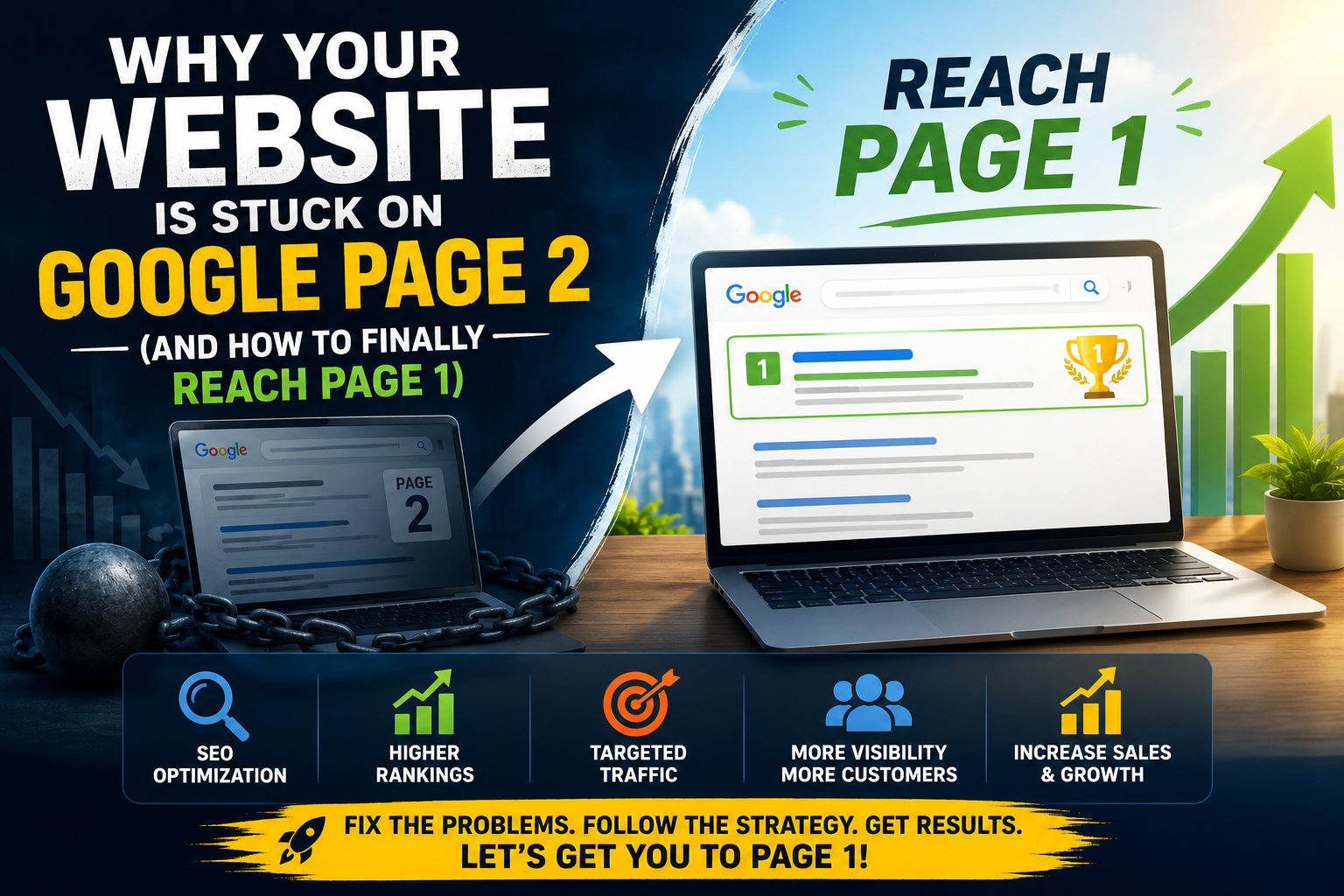
You launched your website with a great design. You invested time in creating content, added your services, optimized your pages, and expected Google to start sending customers your way.
But after months, something frustrating happens.
You search your main keywords on Google and find your website sitting on Page 2, Page 3, or sometimes nowhere near the top results.
This is a situation many businesses experience.
The biggest misconception about SEO is that having a good-looking website and adding keywords is enough to rank on Google. Unfortunately, SEO does not work that way.
Google does not rank websites simply because they exist. It ranks websites that prove they are trustworthy, useful, technically strong, and capable of providing the best answer to a user's search.
A website appearing on Google's first page is usually backed by multiple factors working together:
- Strong technical SEO foundation
- Helpful and detailed content
- Proper keyword targeting
- Quality backlinks
- Positive user experience
- Website authority
- Continuous improvements
At Growthspare, we work with businesses that face the same challenge — they have a website, but they are not getting enough visibility, traffic, or leads from Google.
Through strategic SEO services, we help businesses identify ranking problems, fix technical issues, improve content performance, and create a roadmap for long-term organic growth.
If your website is stuck on Google Page 2, this guide will explain the real reasons behind it and the practical steps you can take to improve your rankings.
Why Getting on Google Page 1 Is Important for Your Business
Think about the last time you searched for a service on Google.
Did you usually check results on Page 2?
Most people don't do right.
The majority of users click websites that appear on the first page because they naturally assume those businesses are more trusted, established, and relevant to them.
Google rankings work similarly to a physical business location.
Imagine two stores selling the same products.
One store is located on the main road where thousands of people walk every day.
The second store is hidden inside a small lane where very few people visit.
Even if both stores offer the same quality, the first store will naturally attract more customers because it has better visibility.
Your Google ranking is your online location.
A higher ranking can help your business achieve:
- More website visitors
- More potential customers
- Stronger brand credibility
- Lower dependency on paid advertising
- Consistent organic leads
- Long-term digital growth
This is why companies invest in professional SEO services in Delhi NCR and other competitive markets. They understand that ranking on Google is not just about traffic — it is about attracting the right audience.
Reason 1: Your Website Does Not Have Enough Authority
One of the biggest reasons websites remain stuck on Page 2 is low website authority.
Google needs confidence before ranking a website above competitors.
It asks questions like:
- Is this website trustworthy?
- Does this brand have industry recognition?
- Do other websites refer to this business?
- Does this website provide valuable information?
Your website authority depends on various factors:
Quality Backlinks
When trusted websites mention or link to your website, Google considers it as a signal of credibility.
For example:
A backlink from a respected industry publication can carry more value than dozens of random links from low-quality websites.
Content Depth
A website with 50 useful, detailed articles often has more authority than a website with only five basic pages.
Brand Presence
Google also considers how visible your brand is across the internet.
Mentions, reviews, business listings, and online reputation all contribute to trust.
Many businesses try to rank quickly by creating hundreds of low-quality backlinks. This approach can actually hurt rankings.
Modern SEO focuses on building genuine authority through:
- Industry-related guest posts
- Digital PR
- Relevant business directories
- Valuable content marketing
- Brand mentions
At Growthspare, our SEO strategy focuses on sustainable growth instead of shortcuts that create temporary ranking improvements.
Reason 2: Your Content Is Not Strong Enough Compared to Competitors
A common question businesses ask is:
"I already have content on my website. Why am I still not ranking?"
The answer:
Because Google does not rank content just because it exists.
Google ranks content that provides the most useful answer.
Your competitors might be ranking higher because their pages are:
- More detailed
- Better researched
- Updated frequently
- Answering customer questions
- Including real examples
- Providing stronger value
For example, if you want to rank for:
"Best SEO Company in Delhi"
A simple 400-word service page will struggle against competitors who have:
- Detailed SEO process explanations
- Client case studies
- Frequently asked questions
- Industry experience
- Results and testimonials
- Supporting blog content
Search engines have become smarter.
The old SEO method of simply repeating keywords does not work anymore.
Your content should answer three important questions:
1. What problem is the customer facing?
Example: "My website receives visitors but no enquiries."
2. What solution does the customer need?
Example: "SEO optimization, better content strategy, and conversion improvements."
3. Why should they trust your business?
Example: "Experience, results, case studies, reviews, and expertise."
Good SEO content is not written only for Google.
It is written for real people who are searching for solutions.
Reason 3: Your Website Has Technical SEO Problems
Many businesses assume that if their website looks good, everything is fine for them.
But SEO is not only about design there are various factors that are also needed to rank.
A website can have an attractive layout, professional images, and impressive branding while still having technical problems that prevent Google from ranking it properly.
Technical SEO is the foundation that helps search engines crawl, understand, and index your website.
Think of it like building a showroom.
A beautiful showroom is useless if customers cannot find the entrance.
Similarly, great content is wasted if Google cannot properly access and understand your website.
Some common technical SEO problems include:
Slow Website Speed
Website speed has become an important ranking and user experience factor.
People today expect websites to load quickly. If your website takes too long, users leave before exploring your services.
A slow website can result in:
- Higher bounce rates
- Lower user engagement
- Fewer enquiries
- Poor ranking performance
Some improvements that can increase website speed include:
- Compressing images
- Using optimized website code
- Improving hosting performance
- Reducing unnecessary plugins
- Implementing browser caching
A faster website does not just help Google rankings — it creates a better experience for your customers.
Mobile Experience Issues
Today, a large percentage of Google searches happen through smartphones.
If your website does not provide a smooth mobile experience, you are losing potential customers.
Common mobile issues include:
- Text that is difficult to read
- Buttons that are hard to click
- Slow loading pages
- Poor navigation
- Incorrect layouts
A mobile-friendly website should:
- Adjust properly to different screen sizes
- Load quickly
- Make information easy to find
- Provide simple navigation
Google wants to rank websites that provide value to users, regardless of which device they use.
Poor Website Structure
Your website structure helps Google understand your business.
A confusing website architecture can make it difficult for search engines to identify your important pages.
A strong structure usually looks like:
Homepage ↓ Main Services ↓ Individual Service Pages ↓ Supporting Blogs ↓ Contact / Conversion Pages
For example:
A digital marketing company should have separate pages for:
- SEO Services
- Google Ads Services
- Social Media Marketing
- Website Development
- Local SEO
Each service page should target specific search intent.
Proper internal linking also helps Google discover and understand your website pages.
Reason 4: Your On-Page SEO Needs Improvement
On-page SEO is one of the areas where many websites lose ranking opportunities.
You may have excellent services, but if your pages are not properly optimized, Google may not understand what keywords you should rank for.
Important on-page SEO elements include:
SEO Title Optimization
Your page title is one of the first things Google and users see.
A weak title:
"Welcome To Our Website"
does not tell Google anything valuable.
A stronger title:
"Professional SEO Services in Delhi NCR | Growthspare"
immediately explains:
- What service you provide
- Your location
- Your brand identity
A good SEO title should be clear, keyword-focused, and written for humans.
Meta Description Optimization
A meta description does not directly decide rankings, but it influences whether people click your website.
A strong description improves click-through rate.
Example:
"Growthspare provides result-driven SEO services in Delhi NCR to improve Google rankings, increase organic traffic, and generate qualified business leads."
It tells users:
- Who you are
- What you offer
- What benefit they can expect
Keyword Optimization
Keywords are still important, but the way businesses use them has changed.
Old SEO:
Repeating the same keyword 50 times.
Modern SEO:
Understanding user intent and naturally using relevant terms.
Your target keywords should appear in:
- Page titles
- Headings
- Website content
- URLs
- Image alt text
- Internal links
For example, instead of only targeting:
"SEO"
you can target:
"SEO services for small businesses in Delhi NCR"
because it matches a stronger buying intention.
Proper Heading Structure
Headings help both users and search engines understand your content.
Example:
H1: Why Your Website Is Stuck on Google Page 2
H2: Reasons Your Website Is Not Ranking
H3: Technical SEO Problems Affecting Rankings
A properly structured page is easier to read and easier for Google to understand.
Reason 5: Your Website Does Not Have Enough Quality Backlinks
Backlinks continue to be one of the strongest trust signals in SEO.
A backlink is when another website links to your website.
Think of backlinks as recommendations.
If several respected websites recommend your business, Google sees your website as more trustworthy.
However, quality matters more than quantity.
For example:
One backlink from a trusted industry website can be more valuable than hundreds of spammy links.
A strong backlink strategy includes:
Guest Publishing
Creating valuable articles for relevant websites in your industry.
Digital PR
Getting your brand mentioned through online publications.
Industry Listings
Building authority through trusted business directories.
Content Promotion
Creating content that naturally attracts links.
Many businesses make the mistake of buying cheap backlinks.
This may create short-term changes but can damage website reputation in the long run.
Professional SEO focuses on earning relevant and trustworthy links.
Reason 6: Your Website Experience Is Not Converting Visitors
Getting traffic is only one part of SEO.
The bigger question is:
"What happens after visitors land on your website?"
Google pays attention to user behavior.
If users visit your website and quickly leave, it may indicate that your page is not satisfying their search.
Important user experience factors include:
- Time spent on website
- Page interaction
- Navigation experience
- Content usefulness
- Mobile experience
Common problems include:
Confusing Navigation
Visitors should immediately understand:
- What you offer
- Who you help
- How they can contact you
Missing Trust Elements
Customers want proof before making decisions.
Add:
- Testimonials
- Case studies
- Client results
- Reviews
- Certifications
Weak Calls To Action
A visitor should know the next step.
Examples:
- Book a free consultation
- Request an SEO audit
- Contact our team
- Get a growth strategy
SEO should not only bring visitors.
It should help convert visitors into customers.
Reason 7: Your Competitors Are Simply Doing Better SEO
Sometimes your website is not failing.
Your competitors are just investing more consistently.
SEO is a competitive game.
Your competitors may be:
- Publishing more useful content
- Updating old articles
- Building stronger backlinks
- Improving website speed
- Creating better landing pages
- Targeting better keywords
This is why competitor analysis is an important part of SEO.
A proper SEO audit helps identify:
- Which keywords competitors rank for
- Their strongest pages
- Their backlink sources
- Missing content opportunities
- Technical advantages
The goal is not to copy competitors.
The goal is to understand what Google considers valuable in your industry and create something better.
How To Move Your Website From Google Page 2 To Page 1
Step 1: Start With a Complete SEO Audit
Before making random changes, understand what is stopping your website growth.
A detailed SEO audit analyzes:
- Technical issues
- Website speed
- Keyword rankings
- Content quality
- Backlink profile
- Competitor performance
- Website structure
Without knowing the problem, SEO becomes guesswork.
Step 2: Improve Existing Website Pages
Many businesses immediately create new pages.
But sometimes the biggest opportunity is improving what already exists.
Update your existing pages with:
- Better information
- New statistics
- More detailed explanations
- Relevant keywords
- Internal links
- Stronger CTAs
A well-optimized existing page can often achieve better results faster than creating a completely new page.
Step 3: Build a Strong Content Strategy
Content is one of the biggest drivers of organic growth.
Create content that answers real customer questions.
Examples:
- SEO guides
- Industry blogs
- Case studies
- Comparison articles
- FAQ pages
- Expert insights
Target long-tail keywords because they often attract users closer to making a purchase.
Example:
Instead of:
"SEO"
Target:
"Best SEO services for small businesses in Delhi NCR"
The second keyword has clearer buying intent.
Step 4: Build Authority Through Quality Backlinks
Create a consistent backlink strategy.
Focus on:
- Relevant websites
- Industry platforms
- Trusted publications
- Business partnerships
Avoid shortcuts.
SEO success comes from building trust over time.
Step 5: Improve Your Conversion Strategy
Ranking on Google is valuable, but generating business results is the real goal.
Your website should include:
- Clear service pages
- Strong CTAs
- Contact options
- Reviews
- Case studies
- Trust signals
A visitor should easily move from:
Google Search → Website Visit → Trust → Enquiry → Customer
How Long Does It Take To Reach Google Page 1?
SEO is not an overnight marketing method.
The timeline depends on:
- Website age
- Competition level
- Industry
- Current rankings
- Website authority
- SEO investment
Generally:
First improvements: 30–90 days
Strong ranking movement: 3–6 months
Highly competitive keywords: 6–12 months
The businesses that win in SEO are usually the ones that stay consistent.
Why Choose Growthspare for SEO Services?
Ranking on Google requires more than adding keywords to a website.
It requires a complete strategy built around understanding your business, your customers, and your competition.
At Growthspare, we help businesses improve their online visibility through customized SEO services in Delhi NCR designed to generate sustainable growth.
Our approach is simple:
Understand the problem → Create the right strategy → Improve visibility → Generate better business opportunities.
We do not believe in shortcuts or temporary ranking tricks.
Our focus is on building a strong SEO foundation that continues to deliver results over time.
Our SEO process includes:
Complete SEO Audit
Before creating a strategy, we analyze your website to identify:
- Technical SEO issues
- Ranking problems
- Keyword opportunities
- Competitor gaps
- Content improvements
This helps us understand exactly what is preventing your website from growing.
Keyword Research & Strategy
Choosing the right keywords is one of the most important parts of SEO.
We identify keywords based on:
- Search volume
- Competition level
- Customer intent
- Business goals
Instead of targeting random high-volume keywords, we focus on keywords that can bring potential customers.
Technical SEO Optimization
A strong website foundation helps Google crawl and understand your website better.
We improve:
- Website speed
- Mobile performance
- Website structure
- Indexing issues
- Internal linking
- Technical errors
Content Optimization
Great content builds trust with both Google and customers.
We optimize content by improving:
- Keyword targeting
- Content structure
- Search intent
- User experience
- Helpful information
Our goal is not just to create content that ranks.
Our goal is to create content that helps users make decisions.
Quality Link Building
Authority matters in SEO.
We focus on building genuine backlinks through:
- Relevant websites
- Industry platforms
- Content marketing
- Digital PR opportunities
This helps improve website credibility and search visibility.
Local SEO Strategy
For businesses targeting specific locations, local SEO plays a major role.
We help businesses improve their presence through:
- Google Business Profile optimization
- Local keyword targeting
- Business citations
- Customer review strategies
This helps businesses appear in front of customers searching for nearby services.
Why Businesses Trust Growthspare
SEO is an investment, not an expense.
A properly executed SEO strategy can help businesses reduce dependency on paid advertising and build a consistent source of organic leads.
Whether you are:
- A startup looking to build online visibility
- A local business trying to attract nearby customers
- An established company wanting more organic growth
Growthspare creates SEO strategies aligned with your business goals.
We combine:
✔ Data-driven SEO strategies ✔ Technical expertise ✔ Content marketing ✔ Competitor research ✔ Conversion-focused optimization
to help businesses build a stronger digital presence.
Final Thoughts: Your Website Can Move From Page 2 To Page 1
If your website is stuck on Google Page 2, do not assume that SEO is not working.
Usually, it means there are areas that need improvement.
Google Page 1 rankings are achieved through a combination of:
- Better content
- Strong technical SEO
- Quality backlinks
- Improved user experience
- Proper keyword targeting
- Continuous optimization
SEO is not about finding a magic trick.
It is about consistently improving your website so Google and users see more value in it.
The websites that rank at the top are not always the oldest websites or the biggest companies.
They are the websites that understand their audience, provide better solutions, and continuously improve.
If your website is struggling to generate traffic, leads, or visibility, the first step is understanding what is holding it back.
At Growthspare, we help businesses identify SEO challenges, create effective growth strategies, and improve their online presence through professional SEO services.
Your competitors are already fighting for Google's top positions.
The question is:
Are you building a strategy to reach Page 1, or are you letting your competitors take those customers?