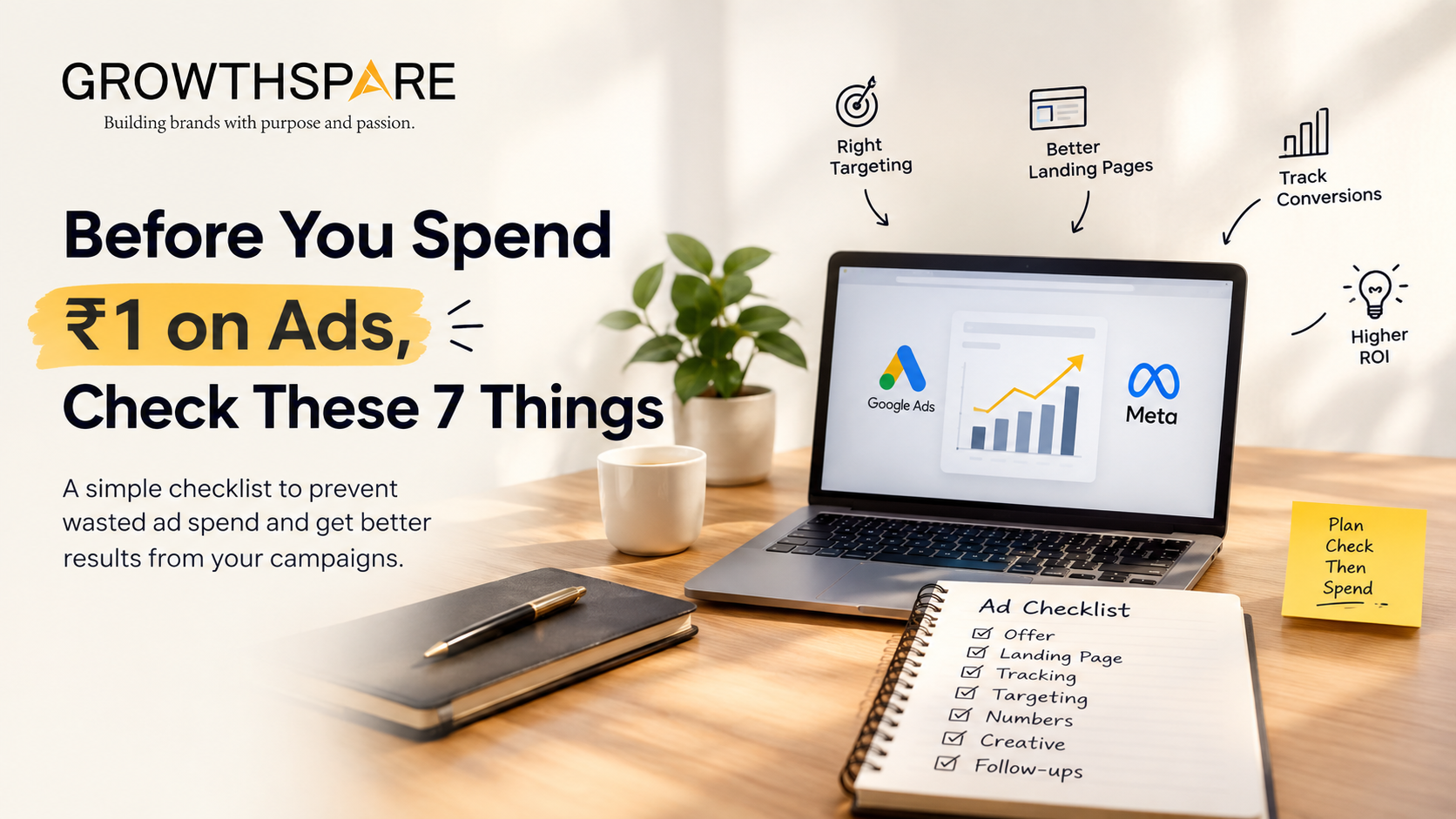
Before You Spend ₹1 on Ads, Check These 7 Things

Growthspare
Sep 19, 2026
You have a good product.
Your website looks professional.
Your social media pages are active.
Your team is ready.
So you do what almost every growing business eventually does:
You start running ads.
₹500 a day.
Then ₹1,000.
Then maybe ₹2,000.
And after a few days, someone asks you the question that nobody wants to answer:
“Where are the customers?”
The uncomfortable truth is that advertising doesn't automatically fix a marketing problem.
Sometimes, the ad isn't the problem.
The problem started before the ad was launched.
Your landing page may not be ready.
Your offer may not be clear.
Your tracking may be broken.
You may be targeting people who were never going to buy.
Or you may simply be spending money to send traffic into a system that wasn't designed to convert it.
At GrowthSpare, we look at paid advertising as more than just pressing the “Publish” button.
Before spending the first ₹1, there are a few things worth checking.
Here are 7 checks every business should make before launching Google Ads, Meta Ads or any other paid campaign.
1. Is Your Offer Actually Clear?
This sounds obvious.
It isn't.
A business owner can spend weeks creating an advertisement without ever asking:
“Why should someone choose us?”
Your customer doesn't know your business the way you do.
They don't know your history.
They don't know how much work goes into your product.
They don't know every feature.
They see an advertisement for a few seconds.
That's it.
So your offer needs to communicate three things quickly:
What are you selling?
Who is it for?
Why should I care?
For example:
“We provide digital marketing services.”
is technically clear—but not particularly compelling.
Compare that with:
“Get more qualified leads from Google with performance-focused SEO and Google Ads.”
The second statement gives the visitor a clearer reason to continue.
Your offer doesn't necessarily need to be cheaper.
It needs to be understandable and relevant.
Before launching your ad, ask:
- Is the product/service immediately clear?
- Is the target customer obvious?
- Is there a specific benefit?
- Is there a reason to act now?
- Is the offer different from what competitors are saying?
If you can't explain the offer in one or two sentences, don't rush into paid traffic.
Fix the message first.
2. Check Your Landing Page Before Sending Traffic
Here's where a lot of advertising budgets quietly disappear.
The advertisement gets the click.
The website loses the customer.
Imagine spending ₹10,000 to bring 300 visitors to your website.
But your landing page takes six seconds to load.
The headline is confusing.
The phone number is difficult to find.
The CTA says “Submit.”
The page doesn't explain pricing.
And on mobile, the entire layout looks broken.
Your ads didn't necessarily fail.
Your post-click experience did.
A landing page should answer the visitor's basic questions quickly:
- What is this?
- Is this relevant to me?
- Why should I trust you?
- What exactly do I get?
- What should I do next?
Don't make the visitor hunt for the answer.
Your pre-ad landing page checklist:
Mobile experience: Does it work properly on a phone?
Speed: Does the page load quickly enough?
Headline: Does it match the advertisement?
CTA: Is the next step obvious?
Trust: Are reviews, credentials, case studies or proof available where appropriate?
Contact: Can people easily call, WhatsApp or submit an enquiry?
A great ad cannot permanently compensate for a poor landing page.
3. Make Sure Your Tracking Actually Works
This is one of the most overlooked parts of paid advertising.
You launch a campaign.
You get traffic.
You receive a few enquiries.
But you don't really know which campaign, audience or advertisement generated them.
That's a problem.
Without proper tracking, you're making decisions based on assumptions.
Depending on your campaign, you may need to track actions such as:
- Form submissions
- Phone calls
- WhatsApp clicks
- Purchases
- Add-to-cart actions
- Lead form submissions
- Booking requests
- Key landing-page actions
For websites using Google Ads, Google Analytics and other platforms, tracking needs to be configured correctly before meaningful performance analysis begins.
And don't stop at tracking clicks.
A click isn't your business goal.
A customer is.
If your campaign generates 1,000 clicks but no meaningful enquiries, celebrating the click-through rate won't solve the problem.
Before launching, ask:
“What action do I actually want the customer to take?”
Then make sure that action can be measured.
4. Don't Target Everyone
One of the most expensive words in advertising is:
Everyone.
A business sells premium interior design services in Delhi.
Instead of targeting potential homeowners or people actively looking for interior design services, the campaign tries to reach almost anybody interested in “home.”
That's a huge audience.
But huge doesn't automatically mean valuable.
Your targeting should reflect your actual customer.
Think about:
Location
Where can you realistically sell?
Delhi?
Gurugram?
Noida?
All of India?
Intent
Is the person actively searching for your service or simply browsing content?
Demographics
Does age, occupation, business size or life stage matter?
Interests and behaviour
Are there meaningful signals that help identify your potential customer?
Buying capacity
Can your audience realistically afford what you're selling?
The exact targeting strategy depends on the platform and campaign objective.
But the principle is simple:
Don't pay to reach people who were never realistic customers in the first place.
Better targeting isn't about making the audience as small as possible.
It's about making it relevant enough to matter.
5. Know Your Numbers Before You Start
This is where advertising becomes a business decision instead of a guessing game.
Before spending ₹10,000, know what ₹10,000 is supposed to achieve.
Let's say your average customer generates:
₹20,000 in revenue.
Your actual profit is obviously lower than that.
Now imagine your campaign produces leads.
Not every lead becomes a customer.
So you need to understand the journey:
Ad → Click → Lead → Qualified Lead → Customer → Revenue
Suppose you generate 50 leads.
If only 5 become customers, your lead-to-customer rate is 10%.
That changes how you evaluate your advertising.
This is why businesses shouldn't obsess over one metric.
A campaign can have a cheap cost-per-lead but poor-quality leads.
Another campaign may generate fewer leads but significantly better customers.
Before spending, establish your basic numbers:
- Average order value
- Gross margin
- Target cost per acquisition
- Expected conversion rate
- Lead-to-customer rate
- Maximum sustainable ad spend
- Monthly advertising budget
You don't need a complicated spreadsheet.
But you do need to know what success looks like financially.
6. Your Creative Should Stop the Scroll
Your audience isn't sitting around waiting for your advertisement.
They're scrolling.
Fast.
So your creative has a difficult job:
Get attention.
Then:
Create interest.
Then:
Give the viewer a reason to act.
A beautiful graphic isn't automatically a good advertisement.
For some businesses, a simple founder video may outperform a highly polished brand film.
For others, a product demonstration may work better.
The important thing is to test the message, format and creative—not just keep changing the campaign budget.
Try different angles:
Problem-led
“Your Google Ads are getting clicks—but where are the leads?”
Benefit-led
“Turn more website visitors into qualified enquiries.”
Proof-led
“Here's what changed after we fixed the campaign.”
Educational
“3 things to check before launching Google Ads.”
Offer-led
“Get a free campaign audit before increasing your ad budget.”
The winning creative isn't always the one that looks the most expensive.
It's often the one that communicates the right message to the right audience at the right moment.
7. Decide What Happens After the Lead Arrives
Here's a mistake that rarely gets discussed in advertising tutorials.
The ad may generate the lead.
But your sales process generates the customer.
Imagine your campaign generates 20 enquiries.
Your sales team responds after 24 hours.
Five people don't answer.
Three have already contacted a competitor.
Four aren't qualified.
And the remaining eight receive a generic message.
Suddenly, the business concludes:
“Facebook Ads don't work.”
But perhaps the advertising did exactly what it was supposed to do.
The bigger problem was what happened after the lead arrived.
Before launching your campaign, decide:
- Who receives the lead?
- How quickly will they respond?
- What questions will they ask?
- How will qualified leads be identified?
- How will follow-ups happen?
- Where will leads be recorded?
- When will a lead be considered lost?
Your marketing and sales process should work together.
Otherwise, you're paying to create opportunities that nobody properly follows up on.
The ₹1 Ad-Spend Test
Before launching your campaign, take one step back.
Don't ask:
“How much should we spend?”
Ask:
“Is the system ready for us to spend?”
Run through this checklist:
Before spending ₹1, check:
☐ Is the offer clear?
☐ Does the landing page work properly?
☐ Is the website mobile-friendly?
☐ Are conversions being tracked?
☐ Are you targeting a realistic customer?
☐ Do you know your numbers?
☐ Is your creative strong enough to earn attention?
☐ Is there a follow-up process for incoming leads?
Notice something?
There are actually eight checks here.
That's intentional.
Because the goal isn't to create a cute seven-point checklist.
The goal is to prevent you from discovering an expensive problem after you've already paid for the traffic.
Ads Don't Fix Everything
Paid advertising can accelerate a business.
But it can also accelerate problems.
If your offer is unclear, you'll get more people seeing an unclear offer.
If your landing page doesn't convert, you'll send more people to a page that doesn't convert.
If your sales follow-up is weak, you'll generate more leads that aren't followed up properly.
That's why successful paid campaigns aren't built around ads alone.
They connect:
Strategy + Offer + Creative + Landing Page + Tracking + Targeting + Sales
When these pieces work together, advertising becomes much easier to understand and optimise.
And when they don't, increasing the budget usually isn't the answer.
Sometimes the smartest move is to stop spending for a moment and fix what's happening between the click and the customer.
Before You Increase Your Ad Budget, Check This
If you're already running Google Ads or Meta Ads, don't automatically assume that increasing the budget will increase your results proportionally.
First ask:
Which campaign is actually producing qualified business?
Which audience is converting?
Which creative is attracting the right people?
Where are prospects dropping off?
What happens after the lead comes in?
Those answers are much more valuable than simply looking at how many clicks your ads generated.
At GrowthSpare, our approach to digital marketing starts from the business objective—not simply from the advertising platform.
Because the goal isn't to generate more traffic.
The goal is to generate better business outcomes.
Final Thought
The easiest way to waste money on advertising isn't necessarily choosing the wrong platform.
It's starting before you're ready.
So before you put ₹1 into Google Ads, Meta Ads or any other paid campaign, stop for a few minutes.
Check the offer.
Check the landing page.
Check the tracking.
Check the audience.
Check the numbers.
Check the creative.
And check what happens after the lead arrives.
Because the cheapest ad campaign is not the one with the lowest budget.
It's the one where every rupee has a clear job.
Need help reviewing your advertising setup before you increase your budget? GrowthSpare can help you identify the gaps across your ads, landing pages, tracking and conversion journey.
Explore GrowthSpare's digital marketing servicesFrequently Asked Questions
1. How much should I spend on Google Ads as a beginner?
There is no fixed amount that works for every business. Your budget should depend on your industry, average customer value, competition, location and conversion rate. Start with a budget you can consistently monitor and optimise rather than increasing spending before you understand the results.
2. Why are my ads getting clicks but no leads?
Clicks only show that people are interacting with your advertisement. If those clicks aren't turning into enquiries, the issue could be your landing page, offer, targeting, pricing, trust signals, page experience or conversion tracking. Look at the complete journey from ad → landing page → enquiry → customer before changing the campaign.
3. How can I reduce wasted ad spend?
Start by checking your targeting, search terms, audience quality, landing page, conversion tracking and campaign objectives. Remove irrelevant traffic and continuously compare the quality—not just the quantity—of leads generated by different campaigns.
4. Should I run Google Ads or Meta Ads?
It depends on how customers discover and purchase your product or service. Google Ads can be useful when people are actively searching for a solution, while Meta platforms can be useful for discovery, visual products, remarketing and audience-based campaigns. The right choice depends on your customer journey and campaign objective.
5. Do I need a landing page for paid advertising?
Not always, but a dedicated landing page can make it easier to match the advertisement with the visitor's intent and guide them toward one specific action. For lead-generation campaigns, a focused landing page can also make measurement and optimisation easier.
6. What should I track in a paid advertising campaign?
Don't look only at clicks. Depending on your business, track metrics such as cost per click, conversion rate, cost per lead, qualified leads, customer acquisition cost and revenue generated. The most useful metrics are the ones connected to your actual business objective.
7. How long should I run an ad campaign before judging it?
There isn't one universal number of days. It depends on your budget, conversion volume, industry, campaign type and sales cycle. Avoid making major decisions from very limited data, but also don't continue spending indefinitely when the campaign is clearly producing irrelevant traffic or failing to meet its objective.
8. Can good ads fix a poor website?
Usually, no. Ads can bring people to your website, but they cannot guarantee that visitors will trust the business, understand the offer or take action. If your website or landing page has major conversion problems, fixing those issues may be more valuable than simply increasing the advertising budget.
9. What is the biggest mistake businesses make with paid advertising?
One common mistake is treating advertising as an isolated activity. A campaign works within a larger system involving the offer, creative, targeting, landing page, tracking and sales follow-up. If one important part of that journey is weak, increasing the ad budget may simply increase the amount of traffic going through a broken step.
10. Should I increase my ad budget if I'm getting leads?
Not automatically. First check whether those leads are relevant and whether they are turning into actual customers. If lead quality, conversion rates and acquisition costs are healthy, you can then evaluate whether increasing the budget makes commercial sense.
11. How do I know if my advertising is actually profitable?
Compare the total cost of acquiring customers with the revenue and margin those customers generate. Looking only at impressions, clicks or leads can give an incomplete picture. Ultimately, the important question is whether the advertising is contributing to sustainable business revenue.
12. Should I hire a digital marketing agency to manage my ads?
It depends on your internal expertise, available time, campaign complexity and advertising budget. If your team doesn't have the experience to manage targeting, creative testing, tracking, landing pages and optimisation, working with an experienced performance marketing team can provide additional expertise and structure.