GPT-6 Astra: A New Generation of Intelligence — What It Means for Businesses and Digital Marketing

Growthspare
Sep 5, 2026
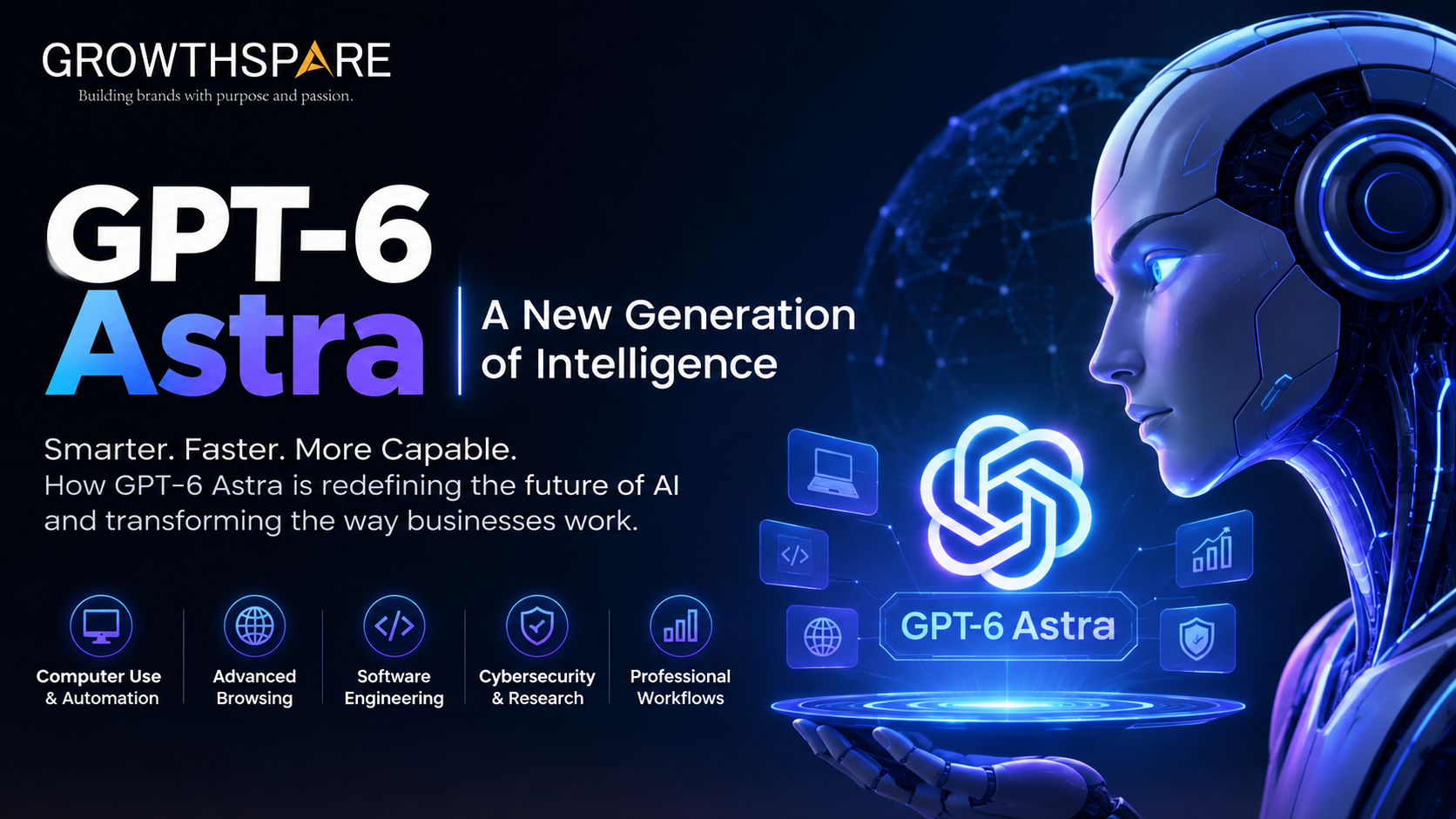
Artificial intelligence is moving quickly, but every once in a while, a new model arrives that changes the conversation.
GPT-6 Astra is one of those moments.
OpenAI has introduced GPT-6 Astra as a new generation of intelligence, positioning it as its most capable and aligned model yet. Unlike earlier AI models that were primarily used for generating text, answering questions or writing code, Astra is designed to handle much more complex, multi-step work across computers, browsers, software development, research and professional workflows.
For businesses, marketers and entrepreneurs, the important question isn't simply:
“How powerful is GPT-6 Astra?”
The better question is:
“What can this change for my business?”
That is where things become interesting.
At Growthspare, we believe AI should not be treated as another marketing buzzword. It should be treated as a business advantage — provided it is used with the right strategy.
What Is GPT-6 Astra?
GPT-6 Astra is OpenAI's latest frontier AI model, introduced in September 2026.
According to OpenAI, Astra brings state-of-the-art capabilities across computer use, browsing, software engineering, cybersecurity, science and professional work. It is designed to reason through complicated tasks, use computers and tools, adapt when requirements change and complete multi-step workflows.
This is an important shift.
Previous generations of AI often worked like this:
You ask → AI responds → You take action.
Astra is increasingly designed around:
You define the objective → AI reasons through the task → AI uses tools → AI completes multiple steps → You review the outcome.
That difference could have a major impact on how companies operate.
OpenAI says Astra can handle tasks such as updating CRM records, completing online forms, conducting research, creating documents and presentations, building websites, testing software and troubleshooting issues on a computer.
In other words, AI is moving closer to becoming an active digital worker rather than simply a chatbot.
Why GPT-6 Astra Matters for Businesses
Businesses don't necessarily need another tool.
They need better outcomes with less wasted time and money.
That is why GPT-6 Astra is particularly interesting for startups, agencies, ecommerce companies and growing businesses.
Consider a typical marketing workflow.
A business might need to:
- Research competitors
- Find relevant keywords
- Analyse website performance
- Create content
- Prepare social media campaigns
- Build landing pages
- Analyse advertising data
- Prepare reports
- Update spreadsheets
- Research customers
- Monitor competitors
- Improve website conversion rates
Traditionally, these activities require several tools and significant manual effort.
AI systems like Astra have the potential to connect many of these activities into larger workflows.
The result?
Less repetitive work and more time for strategy.
That doesn't mean marketers are becoming irrelevant.
Quite the opposite.
As AI becomes better at execution, human strategy becomes more valuable.
GPT-6 Astra and Digital Marketing
This is where businesses should pay close attention.
Digital marketing has always involved a mixture of creative thinking, data analysis and repetitive execution.
GPT-6 Astra could influence all three.
1. SEO Research Could Become More Efficient
SEO isn't simply about putting keywords into an article anymore.
Modern SEO involves:
- Search intent
- Competitor research
- Topical authority
- Content quality
- Internal linking
- Technical SEO
- Entity relationships
- User experience
- Conversion optimisation
- Content distribution
An advanced AI model can potentially help marketers analyse large amounts of information and turn that information into actionable recommendations.
For example, instead of asking an AI:
“Give me 20 SEO keywords.”
A marketer could ask it to analyse a market, identify search opportunities, understand competitor content and build a structured content plan.
That is a much more useful application of AI.
For businesses competing in crowded markets such as Delhi SEO, digital marketing services, ecommerce, real estate, healthcare and professional services, this type of workflow could become particularly valuable.
2. AI Can Change Content Marketing
Content creation is one of the areas where AI has already changed digital marketing.
But there is a problem.
The internet is now flooded with generic AI-written content.
You have probably seen it.
Perfect grammar.
Perfect headings.
Perfectly predictable sentences.
And absolutely nothing memorable.
That is not what businesses need.
The future of AI-powered content marketing isn't about publishing thousands of mediocre articles.
It is about using AI to help marketers:
Research faster → think deeper → create better → test more → improve continuously.
GPT-6 Astra's ability to work across research, computer use and professional tasks could make this workflow considerably more efficient. OpenAI says Astra can produce polished documents, presentations, spreadsheets and analyses while following existing templates and business requirements.
That gives marketing teams more room to focus on positioning, storytelling and customer psychology.
3. Digital Advertising Could Become More Data-Driven
Paid advertising produces huge amounts of data.
Google Ads.
Meta Ads.
YouTube Ads.
LinkedIn Ads.
Each platform generates different metrics and reports.
A marketer has to interpret all of them before making decisions.
AI can help turn raw numbers into useful questions:
- Which campaign is wasting budget?
- Which audience is converting?
- Which creative is losing performance?
- Which landing page needs improvement?
- Where is the biggest drop-off?
- Which campaign deserves more budget?
- What should be tested next?
The important distinction is that AI shouldn't blindly make marketing decisions.
A senior marketer still needs to understand:
Why is the campaign working?
Who is buying?
What is the customer's motivation?
Is the acquisition cost actually profitable?
AI can accelerate analysis.
It doesn't replace business judgment.
4. Websites Could Become More Intelligent
One of the more interesting capabilities highlighted by OpenAI is computer and website interaction.
Astra can work with websites, applications and computer environments, and OpenAI says it can create websites and web apps through Sites in ChatGPT.
For businesses, this could eventually change the website development process.
Imagine being able to describe:
“Build a landing page for a Delhi-based real estate company targeting premium buyers, optimise the structure for conversions, add an enquiry form and test the page.”
Instead of starting everything manually, AI could potentially handle a significant portion of the execution.
But again, execution isn't the difficult part.
Knowing what should be built is.
That requires positioning, customer research and marketing strategy.
5. AI Agents Could Change How Marketing Teams Work
This may be the biggest change.
We are moving from AI that simply generates to AI that can increasingly act.
Think about the difference.
A traditional AI tool might write an email.
An AI agent could potentially:
- Research the customer
- Analyse previous interactions
- Draft the email
- Personalise it
- Update the CRM
- Schedule a follow-up
- Analyse the response
That is a fundamentally different workflow.
OpenAI describes Astra as being built for complex end-to-end work and multi-step tasks, including computer use and tool-based workflows.
For marketing departments, this could eventually mean fewer repetitive operational tasks.
GPT-6 Astra vs Traditional AI Tools
The biggest mistake businesses can make is thinking:
“GPT-6 Astra is just another chatbot.”
It isn't positioned that way.
A traditional chatbot is primarily conversational.
A more advanced AI agent can reason, use tools, navigate environments and perform multiple actions.
Here's the broader difference:
Traditional AI
GPT-6 Astra-style AI
Generates answers
Handles complex workflows
Primarily text-based
Computer and tool interaction
One request at a time
Multi-step tasks
Requires more manual execution
Can automate portions of execution
Content-focused
Professional-work focused
Limited workflow context
Better context handling
Human performs most actions
AI can perform more actions
OpenAI reports that Astra achieves state-of-the-art results across several computer-use and professional-work evaluations, including OSWorld 2.0 and AutomationBench.
That is why businesses should pay attention.
Will GPT-6 Astra Replace Digital Marketers?
No.
But it may replace some of the work digital marketers currently spend their time doing.
That distinction matters.
Imagine two marketers.
Marketer A
Spends most of the day:
- Collecting data
- Formatting reports
- Writing repetitive drafts
- Copying information between tools
- Creating basic variations
- Performing manual research
Marketer B
Spends most of the day:
- Understanding customers
- Developing positioning
- Planning campaigns
- Analysing profitability
- Building offers
- Improving conversion rates
- Testing creative ideas
- Making strategic decisions
AI is much more likely to reduce the workload of Marketer A.
And it can make Marketer B significantly more productive.
The future isn't necessarily:
Human vs AI.
It is:
Human + AI vs Human without AI.
What GPT-6 Astra Means for SEO in 2026
SEO is also changing.
For years, the basic SEO formula was:
Keyword → Article → Backlinks → Rankings
That formula is no longer enough.
Search engines are becoming more sophisticated, users are searching differently and AI-generated answers are changing how people discover information.
Businesses now need to build:
- Strong topical authority
- Helpful content
- Original insights
- Trust
- Brand recognition
- Technical SEO foundations
- Quality backlinks
- Strong user experience
- Conversion-focused landing pages
AI can accelerate the process.
But businesses still need something AI cannot manufacture overnight:
A real brand with real expertise and real reasons for customers to trust it.
That is why companies investing in SEO services, content marketing and digital marketing services should think beyond publishing more content.
The objective should be to build digital authority.
How Businesses Should Prepare for GPT-6 Astra
You don't need to completely rebuild your business because a new AI model has launched.
Instead, start with your existing processes.
Ask:
Which tasks are repetitive?
Identify the work your team performs every week.
Which tasks are data-heavy?
Look at reporting, research and analysis.
Which processes involve multiple tools?
These are often excellent candidates for automation.
Which tasks require human judgment?
Keep these firmly under human control.
Which customer experiences could be improved with AI?
This is where AI can move beyond internal productivity and directly influence revenue.
The goal shouldn't be:
“Let's use AI because everyone else is using AI.”
The goal should be:
“Where can AI create a measurable business advantage?”
The Growthspare Perspective: AI Is a Marketing Advantage, Not a Marketing Strategy
This is the part many businesses get wrong.
AI can produce content.
AI can analyse data.
AI can help with research.
AI can automate workflows.
AI can accelerate execution.
But AI doesn't automatically know:
What your customer wants.
Why they should choose you.
What makes your brand different.
Which offer will actually sell.
How much you should spend to acquire a customer.
Those are marketing questions.
And that's where strategy still matters.
At Growthspare, we look at AI as an accelerator for digital marketing — not as a replacement for marketing fundamentals.
The strongest businesses will combine:
AI + SEO + Paid Advertising + Content + Social Media + Conversion Optimisation + Human Strategy.
That combination is much more powerful than simply generating AI content.
Is GPT-6 Astra Worth Paying Attention To?
Absolutely.
Whether you're a startup founder, marketing manager, ecommerce business owner or established company, AI is becoming increasingly integrated into everyday business operations.
GPT-6 Astra represents another significant step in that direction.
OpenAI says Astra is designed for complex reasoning, coding, research, computer use and professional work, with access rolling out through ChatGPT plans and the OpenAI API.
But the real opportunity isn't the model itself.
The opportunity is what businesses build on top of it.
Companies that learn how to combine AI with strong marketing systems could operate faster, test more ideas and make better-informed decisions.
Companies that simply generate generic AI content will struggle to stand out.
Final Thoughts
GPT-6 Astra isn't just another AI model announcement.
It represents the direction the industry is moving toward:
AI that doesn't simply answer questions — but increasingly helps complete the work.
For marketers, that means the value of repetitive execution will decline while the value of strategy, creativity, positioning, analysis and human judgment will increase.
Businesses shouldn't be asking:
“Should we use GPT-6 Astra?”
They should be asking:
“Which parts of our business could become dramatically better if we used advanced AI correctly?”
That's the real opportunity.
And as AI continues to evolve, the businesses that combine technology with a strong digital marketing strategy will have a serious advantage.
Frequently Asked Questions About GPT-6 Astra
What is GPT-6 Astra?
GPT-6 Astra is OpenAI's latest advanced AI model, designed for complex reasoning, computer use, coding, research, cybersecurity and professional workflows.
Is GPT-6 Astra better than previous GPT models?
OpenAI positions GPT-6 Astra as its most capable model and reports significant improvements across computer use, professional work, coding, reasoning and other evaluations.
Can GPT-6 Astra help with digital marketing?
Yes. Its capabilities in research, computer use, document creation, analysis and multi-step workflows can potentially support SEO research, content planning, reporting, campaign analysis and other marketing operations.
Will GPT-6 Astra replace digital marketing agencies?
Not completely. AI can automate and accelerate many tasks, but strategy, positioning, creativity, customer understanding and business decision-making remain critical.
How will GPT-6 Astra affect SEO?
AI will make SEO research, content production and analysis more efficient. However, businesses will still need high-quality content, technical SEO, authority, brand trust, original expertise and strong user experience to compete.
Should small businesses use GPT-6 Astra?
Small businesses can potentially benefit from advanced AI by reducing repetitive work, accelerating research and improving productivity. The best approach is to identify specific business processes where AI can produce measurable results.
About Growthspare
Growthspare is a digital marketing platform helping businesses build stronger online visibility through SEO, paid advertising, content marketing, social media and performance-focused digital strategies.
We believe the future of marketing isn't about choosing between humans and AI.
It's about using both intelligently.
Want to make AI work for your business?
Talk to Growthspare about building a digital marketing strategy designed for the next generation of search and AI.