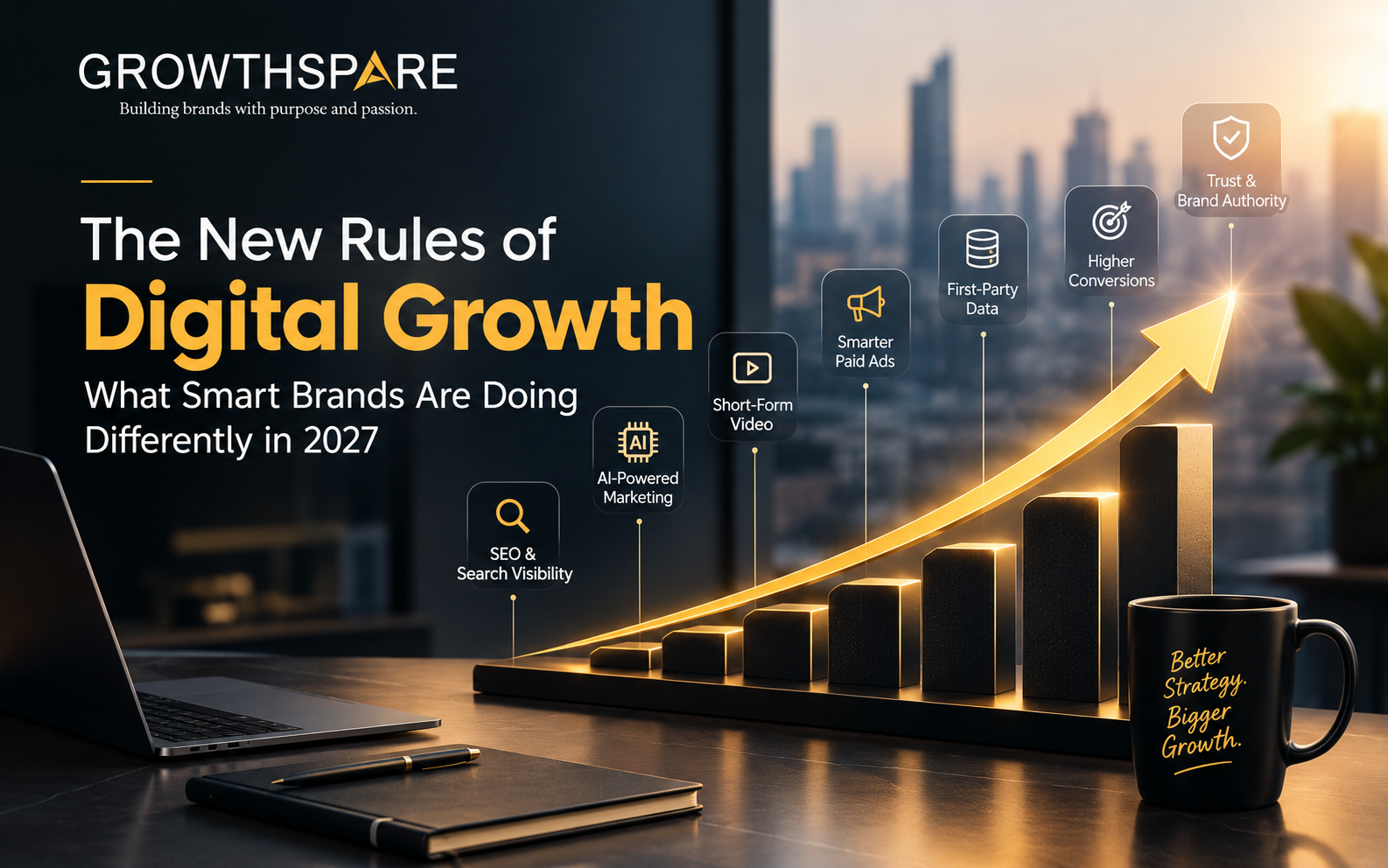
The New Rules of Digital Growth: What Smart Brands Are Doing Differently in 2027

Growthspare
Sep 9, 2026
Digital marketing is entering a different phase.
For years, businesses were taught a familiar formula: publish more content, target more keywords, increase ad budgets, collect followers, and try to rank higher on Google.
That formula is becoming less reliable.
In 2027, digital growth will increasingly depend on how well a business understands its customers, creates useful experiences, builds trust, uses data intelligently, and adapts to AI-powered search and advertising.
Google itself has confirmed that SEO fundamentals remain important as AI Overviews and AI Mode evolve. At the same time, Google is placing greater emphasis on unique, useful, people-first content rather than generic content created simply to capture search traffic.
So what are smart brands doing differently?
They are not simply “doing more marketing.”
They are building better digital growth systems.
1. Smart Brands Are Moving From Marketing Campaigns to Growth Systems
One of the biggest changes in digital marketing is the shift from isolated campaigns to connected growth systems.
A business may previously have run:
- Google Ads
- Instagram campaigns
- SEO
- Email marketing
- Content marketing
- Influencer campaigns
as separate activities.
In 2027, the stronger approach is to connect them.
A customer might discover your brand through Google, watch a short-form video, visit your website, read a comparison article, see a retargeting advertisement and finally purchase after receiving an email or WhatsApp message.
The individual channels matter.
But the customer journey matters more.
This is why businesses should stop asking:
“How much should we spend on Google Ads?”
and start asking:
“Where are customers discovering us, what convinces them, and what makes them convert?”
That change in thinking can completely transform a digital marketing strategy.
2. SEO Is Becoming More About Visibility Than Just Rankings
The traditional SEO goal was simple:
Get to position #1.
But search is no longer limited to ten blue links.
Google is expanding AI-powered experiences such as AI Overviews and AI Mode, creating new ways for users to discover information and websites. Google says its generative AI experiences continue to rely on its core Search systems and foundational SEO practices.
That means businesses should think beyond rankings.
The bigger question is:
Can your brand become visible wherever your potential customer searches?
That includes:
- Traditional Google results
- AI-powered search experiences
- Local search
- YouTube
- Images
- Shopping results
- Social platforms
- Review platforms
- Industry websites
- Communities and discussions
This doesn't mean abandoning traditional SEO.
Quite the opposite.
Technical SEO, crawlability, internal linking, useful content, page experience and strong information architecture remain important foundations.
The difference is that SEO is becoming part of a larger digital visibility strategy.
3. Generic AI Content Won't Be Enough
AI has dramatically changed content production.
A business can now generate hundreds of articles, social posts, product descriptions and advertising variations within a fraction of the time previously required.
But speed does not automatically create authority.
If thousands of websites publish essentially the same AI-generated article, why should Google—or a customer—prefer yours?
This is where original expertise becomes valuable.
Google's current guidance specifically emphasizes unique, useful, non-commodity content and warns against producing large amounts of content primarily to manipulate search rankings.
Smart brands will therefore use AI as an accelerator rather than a replacement for expertise.
The winning content will include:
- Original research
- First-hand experience
- Expert opinions
- Customer examples
- Original data
- Unique frameworks
- Case studies
- Real comparisons
- Practical insights
In simple terms:
AI can help you create faster. Your expertise gives people a reason to care.
4. First-Party Data Will Become More Valuable
Digital marketing has always depended on data.
But businesses are increasingly realizing that not all data is equally valuable.
A social media follower may be useful.
A website visitor may be more valuable.
But someone who has purchased from you, requested a quotation, subscribed to your newsletter or interacted with your brand repeatedly can provide much stronger signals.
Smart businesses are therefore building their own customer databases and relationships.
This includes:
- Email subscribers
- CRM data
- Website leads
- Customer purchase history
- WhatsApp conversations
- Repeat customers
- Loyalty programs
- Product preferences
- Customer feedback
Instead of constantly paying to rediscover the same audience, brands can use their first-party data to build stronger remarketing, personalization and retention strategies.
The future advantage isn't simply having more data. It's knowing how to use your own data intelligently.
5. Paid Advertising Will Become More Strategic
Throwing money at advertising doesn't create growth.
It amplifies whatever already exists.
If your landing page is weak, advertising can bring more people to a weak landing page.
If your offer is unclear, more impressions won't fix it.
If your targeting is wrong, a larger budget can simply create more wasted clicks.
Smart brands are approaching paid advertising as a complete conversion system.
That means looking at:
Ad → Landing Page → Offer → Trust → Conversion → Follow-up → Retention
For example, an ecommerce brand shouldn't only ask how many purchases came from an ad.
It should understand:
- Which creative generated attention?
- Which audience converted?
- Which product had the strongest economics?
- What was the cost per customer?
- What was the repeat purchase rate?
- Which customers became high-value customers?
This is the difference between running ads and building an acquisition engine.
6. Short-Form Video Is Becoming a Search and Discovery Channel
Consumers don't only search Google anymore.
They search through YouTube, Instagram, TikTok, marketplaces, social communities and increasingly AI-powered interfaces.
Short-form video has therefore become more than a branding tool.
It can introduce a problem, demonstrate a product, answer a question, establish expertise and send users deeper into the customer journey.
For businesses, this means video content should not be created randomly.
A stronger strategy connects videos to actual customer questions.
For example:
Problem: “Why are my Google Ads not generating leads?”
Video: “3 reasons your Google Ads campaign is wasting money.”
Next step: Detailed website guide.
Conversion: Free audit or consultation.
Now the video is not just content.
It becomes part of the growth funnel.
7. Conversion Rate Will Matter as Much as Traffic
One of the biggest mistakes businesses make is celebrating traffic without understanding what happens after the visitor arrives.
Imagine two companies.
Company A gets 50,000 monthly visitors and converts 0.5%.
Company B gets 10,000 visitors and converts 5%.
Company B may generate the same number of conversions with significantly less traffic.
That's why smart brands are focusing heavily on conversion rate optimization (CRO).
They are improving:
- Landing pages
- Headlines
- Calls-to-action
- Website speed
- Mobile experience
- Product pages
- Forms
- Trust signals
- Reviews
- Pricing presentation
- Checkout experiences
The goal is not simply:
“Get more visitors.”
The goal is:
“Get more value from every visitor.”
8. Trust Is Becoming a Competitive Advantage
Customers have more choices than ever.
They can compare prices, reviews, products, agencies and businesses within minutes.
That makes trust a major competitive advantage.
Smart brands are investing in:
- Authentic reviews
- Case studies
- Expert content
- Transparent information
- Strong brand identity
- Customer testimonials
- Demonstrations
- Original research
- Consistent communication
For local businesses, even fundamentals such as an accurate Google Business Profile, reviews and consistent business information can influence how customers discover and evaluate the company.
For online brands, trust needs to appear throughout the customer journey.
A customer shouldn't have to wonder:
“Can I trust this company?”
The website, content, reviews, branding and communication should answer that question naturally.
9. AI Will Change the Role of the Digital Marketer
The digital marketer of 2027 won't necessarily compete with AI.
They will compete with marketers who know how to use AI better.
AI can assist with:
- Research
- Data analysis
- Content ideation
- Customer segmentation
- Creative variations
- Ad testing
- Reporting
- Automation
- Personalization
- Workflow optimization
But strategic judgment remains critical.
Someone still needs to decide:
What should we do?
Why should we do it?
Who are we targeting?
What makes our brand different?
What should we stop doing?
That is where strategic marketing expertise becomes even more valuable.
10. The Best Brands Will Connect SEO, AI, Ads and Content
The biggest opportunity isn't choosing between SEO and paid advertising.
Or between AI and human creativity.
Or between social media and search.
The opportunity is connecting them.
Imagine this system:
SEO brings long-term organic visibility.
AI-assisted research helps identify customer questions and opportunities.
Content builds authority.
Social media creates discovery and engagement.
Paid advertising accelerates acquisition.
CRO improves conversion.
CRM and remarketing bring customers back.
Analytics tells the business what is actually working.
That is what modern digital growth looks like.
What Should Businesses Do in 2027?
Businesses don't need to completely rebuild everything overnight.
Instead, start with five questions:
1. Can customers easily find us?
Review your SEO, local search, social presence and overall online visibility.
2. Is our content genuinely useful?
Remove generic content and create material based on expertise, experience and customer problems.
3. Are we measuring conversions?
Don't focus only on impressions, followers and traffic. Track leads, sales, customer acquisition costs and revenue.
4. Are we using AI intelligently?
Use AI to improve speed, analysis and productivity—but keep human expertise at the center.
5. Is our digital strategy connected?
Your SEO, advertising, content, social media and website should work toward the same business objectives.
The Real Rule of Digital Growth in 2027
The biggest digital marketing change isn't another algorithm.
It isn't another AI tool.
It isn't another social media platform.
It is a change in how businesses think about growth.
The brands that win will stop treating digital marketing as a collection of individual services.
They will treat it as a connected business growth system.
At Growthspare, we believe the future of digital marketing belongs to businesses that combine strategy, SEO, content, paid media, technology and conversion thinking into one clear growth roadmap.
Because the objective isn't to simply get more clicks.
It is to create visibility that turns into trust, trust that turns into customers, and customers that turn into sustainable growth.
And in 2027, that difference will matter more than ever.