From One Idea to 30 Reels: How AI Can Speed Up Content Creation

Growthspare
Sep 30, 2026
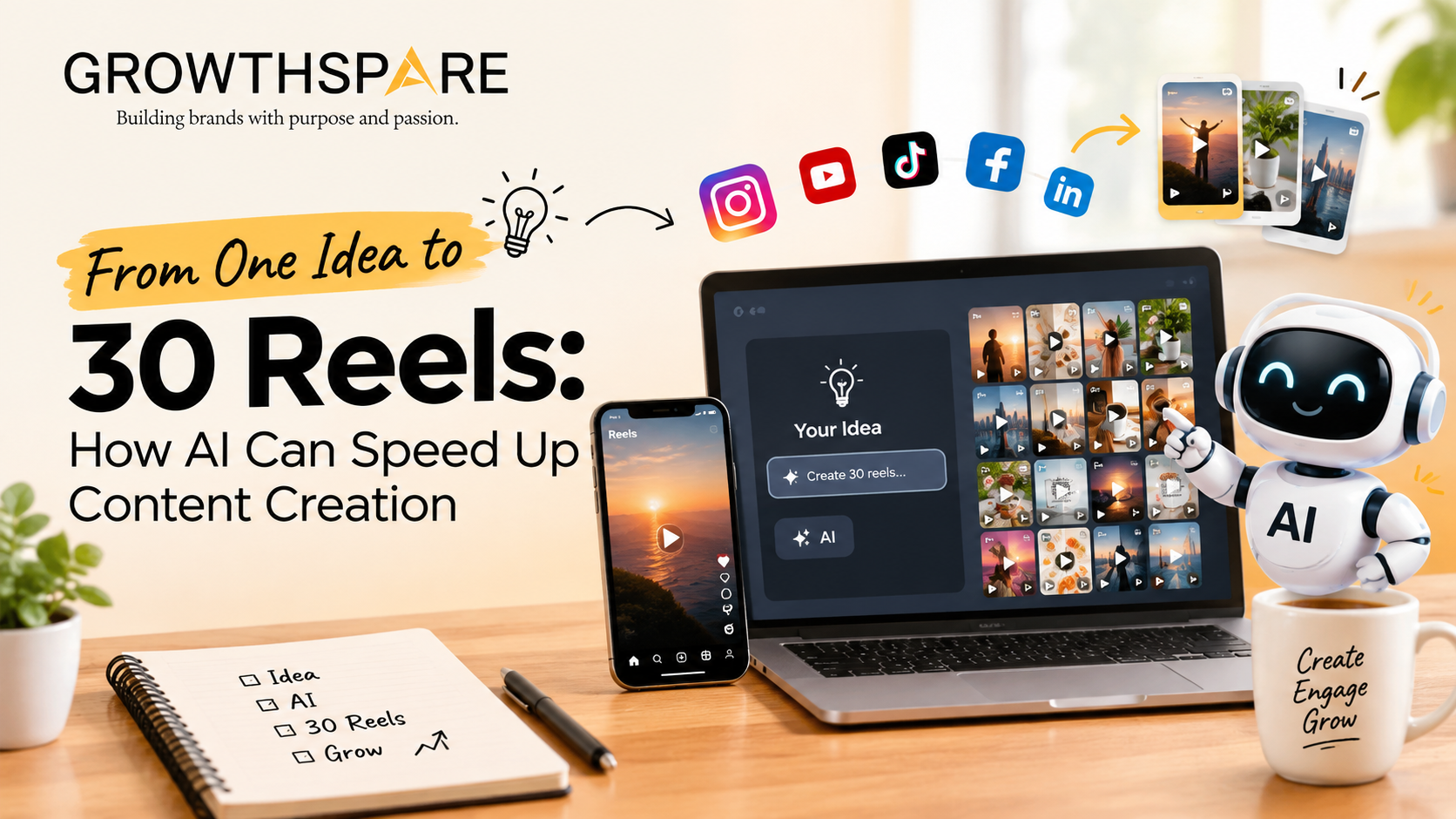
Creating content consistently sounds easy until you actually have to do it.
One Instagram Reel becomes two, then five, then ten. Soon, the pressure is not just about creating videos—it is about finding ideas, writing hooks, preparing scripts, shooting, editing videos, adding captions, designing thumbnails, publishing, and tracking performance.
For businesses, founders, creators, and marketing teams, this can quickly become a full-time job for them.
But what if one strong content idea could become 30 different Reels? yes you heard it right.
That is where artificial intelligence is changing the content creation process.
AI is not replacing creativity. Instead, it can help marketers take one strong idea and turn it into multiple content angles, scripts, hooks, formats, and variations much faster and easier.
At Growthspare, we see AI as a productivity layer for marketing—not a replacement for strategy. The real advantage comes when human creativity, brand knowledge, audience understanding, and AI-powered workflows work together.
In this guide, we will explain how you can turn one idea into 30 Reels using AI while keeping your content useful, relevant, and connected to your brand.
Why Content Creation Feels So Difficult
The biggest challenge with social media content is not always a lack of ideas.
It is the pressure to create new content every day.
A typical Reel may require:
- A content idea
- A strong opening hook
- A script
- Visual direction
- On-screen text
- Voiceover
- Editing
- Caption writing
- Hashtags or keywords
- A thumbnail
- A publishing schedule
Doing this repeatedly can consume significant time and efforts.
This is why content repurposing has become such an important part of modern digital marketing.
Instead of asking:
“What should we post today?”
A better question is:
“How many useful pieces of content can we create from this one idea?”
That small change in thinking can completely change your content workflow.
The One-Idea-to-30-Reels Framework
Let's take a simple example.
Suppose your original idea is:
“Why your Instagram posts get views but no customers.”
Instead of creating only one Reel around this topic, AI can help you break it into dozens of smaller content angles.
For example:
- Why views don't always mean sales
- Three reasons Instagram followers don't buy
- The biggest mistake businesses make with Reels
- How to create Reels that attract potential customers
- Views vs. leads: what's the difference?
- Why viral content can sometimes generate poor-quality leads
- How to improve your Reel CTA
- Three CTA mistakes businesses make
- How to turn educational content into leads
- What makes people stop scrolling?
- The psychology of a strong Reel hook
- Five hooks businesses can test
- Why your first three seconds matter
- How to structure a 15-second Reel
- How to structure a 30-second Reel
- One topic, three different Reel formats
- Before-and-after content strategy
- Common Instagram marketing myths
- A quick Instagram audit checklist
- Signs your content strategy needs improvement
- What your Instagram analytics are telling you
- How to identify your best-performing topics
- Why repeating successful topics is not bad
- How to turn customer questions into Reels
- How to use comments for content ideas
- Three content ideas from one customer problem
- Educational vs. promotional Reels
- How to create a soft-selling Reel
- How to build a weekly Reel series
- The complete Instagram content workflow
One idea has now become an entire month of potential content.
That is the real power of AI-assisted content planning.
Step 1: Start With One Strong Core Idea
AI works best when the starting idea is good.
Don't begin with:
“Give me 30 viral Reel ideas.”
Instead, give AI context.
For example:
Core topic: Instagram marketingAudience: Small business ownersGoal: Generate leadsBrand: Digital marketing agencyTone: Professional but conversationalPlatform: InstagramContent style: Educational + practical
This gives AI enough information to create content that actually supports your marketing strategy.
At Growthspare, the principle is simple:
Strategy first. AI second.
AI can generate hundreds of ideas, but your marketing strategy decides which ideas are worth publishing.
Step 2: Ask AI to Find Different Content Angles
The next step is content expansion.
Take your core topic and ask AI to break it into different angles.
For example:
Educational Angle
“Why your Instagram content isn't converting.”
Mistake Angle
“Three Instagram mistakes that are costing you customers.”
Myth Angle
“More followers don't automatically mean more sales.”
Checklist Angle
“Five things to check before publishing your next Reel.”
Case Study Angle
“How changing one CTA can improve lead generation.”
Storytelling Angle
“We posted consistently for 30 days. Here's what happened.”
Contrarian Angle
“You don't need to post every day to grow on Instagram.”
Tutorial Angle
“How to create a Reel that takes viewers from attention to action.”
These different angles prevent your content from becoming repetitive.
Step 3: Turn Each Angle Into a Reel Hook
The first few seconds of a Reel matter because users decide very quickly whether they want to continue watching.
AI can help generate multiple hooks for the same topic.
For example, instead of:
“Here are three Instagram marketing tips.”
You could test:
“Your Instagram isn't failing because you need more followers.”
Or:
“Getting views but no customers? Check these three things.”
Or:
“Before you create another Reel, fix this.”
The underlying topic remains the same.
The presentation changes.
This is important because content performance can depend heavily on how an idea is packaged.
Step 4: Create Multiple Reel Formats
One topic does not need to look the same every time.
You can turn the same idea into different formats.
Talking-Head Reel
A marketer explains the concept directly to camera.
Text-Based Reel
The information appears through animated text and visuals.
Screen Recording
Show an actual Instagram profile, analytics screen, website, or marketing process.
Listicle
“5 reasons your Reels aren't converting.”
Story Reel
Start with a problem, explain what happened, and finish with the lesson.
Before-and-After
Show the difference between weak and improved content.
FAQ Reel
Answer a question customers repeatedly ask.
Myth-Busting Reel
Take a common assumption and explain what marketers should actually consider.
By changing the format, you can reuse the same strategic idea without making your audience feel like they are watching the same content repeatedly.
Step 5: Use AI to Build the Scripts
Once you have the topics and formats, AI can help turn each idea into a script.
A simple Reel structure can be:
Hook → Problem → Insight → Solution → CTA
For example:
Hook:“Your Instagram can get thousands of views and still generate zero customers.”
Problem:“That's because attention and conversion are two different things.”
Insight:“If your content attracts people who are interested but gives them no reason to take the next step, your views may never become leads.”
Solution:“Connect your educational content with a clear customer problem and a relevant CTA.”
CTA:“Save this before creating your next Reel.”
The important point is that AI provides the framework and speed.
Your marketing team should still check the script for accuracy, brand voice, originality, and relevance.
Step 6: Create 30 Reels Without Creating 30 Completely New Ideas
This is where the workflow becomes efficient.
You don't need 30 completely unrelated ideas.
You need 30 useful perspectives around one broader subject.
For example:
Pillar Topic:
Instagram Lead Generation
From that one pillar, you can create:
- Problems
- Mistakes
- Tips
- Tutorials
- Myths
- FAQs
- Case studies
- Statistics
- Checklists
- Examples
- Stories
- Comparisons
- Tools
- Processes
- Lessons learned
This is known as content clustering.
It helps create consistency while keeping the individual pieces of content different.
A Simple AI Content Workflow
A practical AI-assisted workflow could look like this:
Step 1: Choose one marketing topic.
↓
Step 2: Ask AI for 30 content angles.
↓
Step 3: Group the ideas into content pillars.
↓
Step 4: Create 3–5 hooks for each important topic.
↓
Step 5: Select the strongest ideas.
↓
Step 6: Generate short Reel scripts.
↓
Step 7: Add your own examples, data, opinions, and brand insights.
↓
Step 8: Produce the videos.
↓
Step 9: Create captions and supporting content.
↓
Step 10: Publish, measure, and improve.
This turns content creation from a daily scramble into a repeatable marketing system.
AI Should Speed Up Marketing—Not Make It Generic
There is one major problem with using AI for content.
Everyone can use the same AI tools.
That means simply generating generic content is not a competitive advantage.
If 100 businesses ask AI:
“Give me 10 Instagram marketing tips.”
They may receive very similar answers.
The competitive advantage comes from what happens after AI generates the first draft.
Add:
- Your company's experience
- Customer questions
- Real campaign examples
- Original data
- Industry-specific insights
- Your brand's tone
- Human stories
- Real results
- Strong opinions based on experience
This is where content becomes distinctive.
AI can help produce the structure.
Your expertise gives it value.
How Growthspare Can Use This Strategy
For a digital marketing company such as Growthspare, the one-to-30 model can be applied across multiple marketing topics.
For example:
SEO
One topic:
“Why your website isn't ranking.”
Possible Reels:
- Three common SEO mistakes
- Why publishing more blogs may not solve the problem
- Search intent explained
- Internal linking mistakes
- Technical SEO basics
- How Google understands content
- SEO myths
- Keyword research mistakes
- On-page SEO checklist
- How to improve existing content
Social Media Marketing
One topic:
“Why your Instagram isn't generating leads.”
Possible Reels:
- Weak CTA
- Wrong audience
- Poor positioning
- Generic content
- Profile optimization
- Content funnel
- Lead magnets
- Social proof
- Educational content
- Conversion-focused content
AI Marketing
One topic:
“How AI is changing digital marketing.”
Possible Reels:
- AI for content research
- AI for social media ideas
- AI for SEO workflows
- AI for competitor research
- AI for content repurposing
- AI for customer research
- AI for ad copy testing
- AI for marketing automation
- AI limitations
- Human + AI marketing workflows
One pillar can therefore support weeks of content.
The Real Benefit: A Repeatable Content Engine
The biggest benefit of AI-assisted content creation is not simply saving a few hours.
It is creating a repeatable content engine.
Instead of starting from zero every Monday, your team can work from a structured system.
One monthly theme can produce:
30 Reels + 4–8 carousel posts + blog content + LinkedIn posts + Facebook posts + email content + story ideas.
That means your social media strategy becomes connected to your broader content strategy.
A Reel can introduce an idea.
A blog can explain it in depth.
A LinkedIn post can discuss the business implication.
A carousel can turn the concept into a checklist.
An email can provide additional insights.
This is how content starts working as an ecosystem instead of a collection of random posts.
Final Thoughts
AI has made content production faster, but speed alone does not create successful marketing.
The real opportunity is using AI to remove repetitive work so marketers can spend more time on strategy, creativity, research, positioning, and customer understanding.
One strong idea can become 30 Reels.
But those 30 Reels should not feel like 30 copies of the same post.
They should answer different questions, address different problems, test different hooks, and provide different reasons for someone to stop scrolling.
At Growthspare, we believe the future of content creation is not AI versus humans.
It is human strategy + AI efficiency.
The brands that understand that difference can build content systems that are faster, more consistent, and easier to scale.
Don't ask AI to create everything for you.
Ask it to help you turn your best ideas into more opportunities to connect with your audience.
Frequently Asked Questions
1. Can AI really turn one idea into 30 Reels?
Yes. A strong topic can be divided into multiple angles such as tips, mistakes, FAQs, tutorials, myths, examples, case studies, and storytelling formats. AI can help generate and organize these variations.
2. Will AI-generated Reels feel repetitive?
They can if the same script and format are reused. Using different hooks, perspectives, formats, examples, and audience problems can make each Reel more distinct.
3. Does AI replace a social media manager?
AI can automate or accelerate parts of the workflow, but strategy, brand positioning, creative judgment, audience understanding, and quality control still require human input.
4. How many Reels can you create from one topic?
There is no fixed number. A well-developed content pillar can potentially produce dozens of different content pieces depending on the audience and subject.
5. Is AI content good for SEO and social media?
AI can assist with research, ideation, outlines, and content production. However, content should be reviewed and improved with original expertise, accurate information, useful examples, and a clear audience purpose.
6. How can a digital marketing agency use AI for content?
An agency can use AI to accelerate research, content ideation, script development, repurposing, content calendars, caption drafting, and workflow management while keeping strategy and final quality control human-led.
About Growthspare
Growthspare helps businesses build stronger digital visibility through SEO, social media marketing, content marketing, and digital growth strategies.
The goal is not simply to create more content.
It is to create content that supports a larger marketing objective—visibility, engagement, leads, and long-term brand growth.