Your Next Customer May Never Visit Google — Here’s Why

Growthspare
Sep 26, 2026
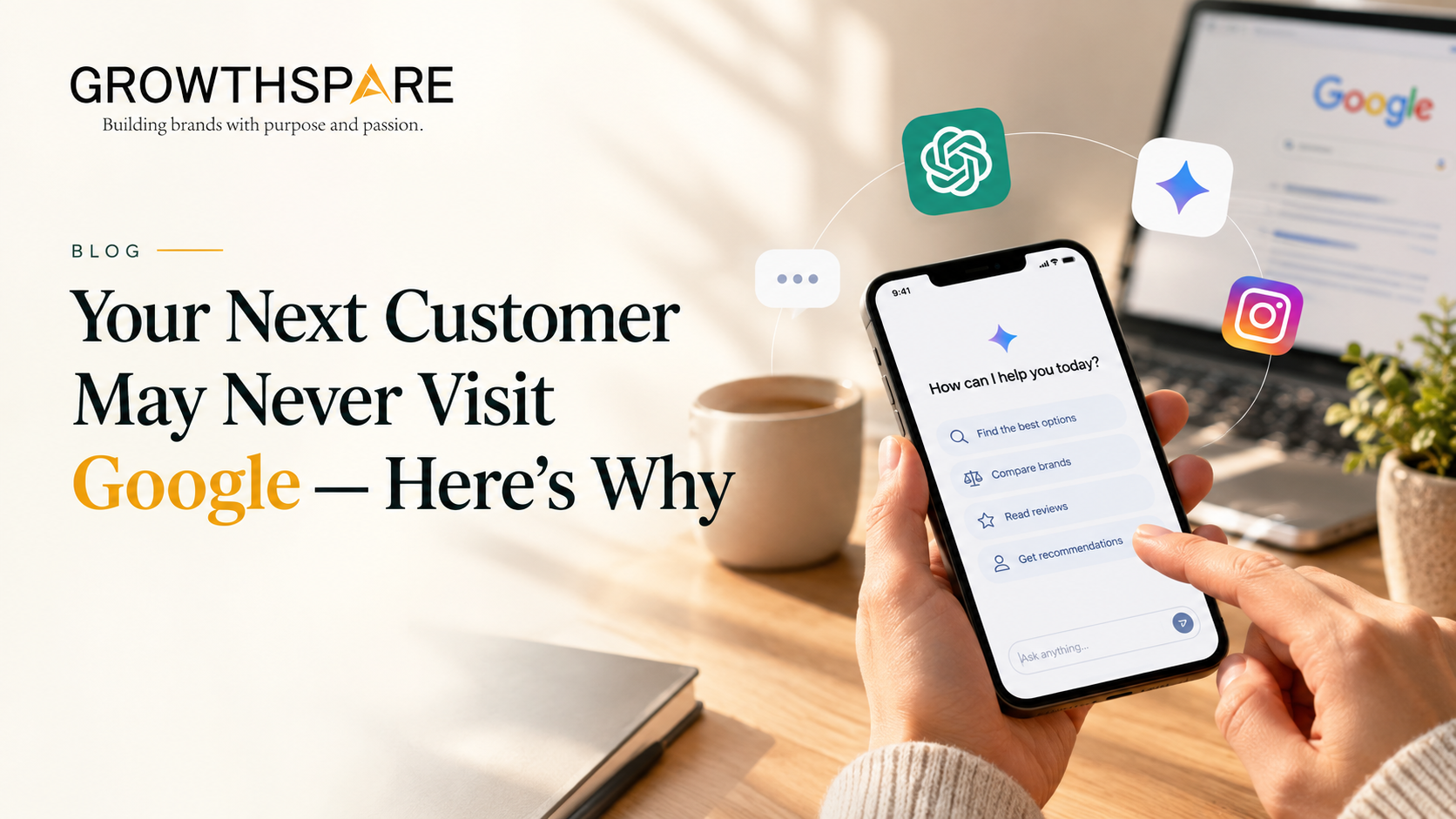
For years, the customer journey online has been relatively predictable.
Someone needs a product or service. They open Google. They type a search. They look through websites, compare options, read reviews and eventually contact a business.
That journey is now changing.
People increasingly have another option: ask AI.
Instead of searching for “best digital marketing agency for small business,” someone can ask an AI assistant to recommend agencies, compare approaches, explain pricing models and even help them decide what type of marketing strategy they need.
The search doesn't necessarily end with ten blue links.
The answer may come directly from the AI.
For businesses, this creates an important question:
What happens when your potential customer finds an answer without ever visiting Google?
At Growthspare, we believe this is one of the biggest changes marketers need to understand as search evolves.
Search Is Becoming More Conversational
Traditional search usually starts with keywords.
For example:
“digital marketing agency Delhi”
AI search is different.
A user might ask:
“I run a small business and have a limited marketing budget. Should I invest in SEO, Instagram or Google Ads first?”
That's not simply a keyword.
It's a business problem.
AI-powered search can interpret the context behind the question and provide a more conversational response.
This changes the job of SEO.
The goal isn't only to rank a webpage for a particular keyword anymore.
Businesses increasingly need to create content that answers real questions clearly, demonstrates expertise and provides useful information that AI systems can understand and reference.
Google Isn't Disappearing — But Search Is Expanding
It's important not to misunderstand the shift.
This doesn't mean Google suddenly becomes irrelevant.
Google remains a major source of online discovery, and traditional SEO continues to matter.
The bigger change is that Google is no longer the only place where people can begin their research.
AI assistants and AI-powered search experiences are becoming another layer between the customer and the internet.
Think about the difference.
Traditional journey
Customer → Google → Search results → Website → Business
AI-assisted journey
Customer → AI → Answer/recommendation → Business
Sometimes the customer may still click through to a website.
But sometimes the answer itself may influence their decision.
That creates a new visibility challenge for businesses.
The New SEO Question: Can AI Understand Your Brand?
For years, marketers asked:
“How do we rank this page?”
Now another question deserves attention:
“Does AI understand what our business does?”
Imagine a customer asking:
“Which companies provide SEO and digital marketing services for small businesses?”
If an AI system doesn't clearly understand your company's services, expertise, location, audience or areas of specialization, your website may not become part of the answer.
This is why AI SEO is becoming an important area of digital marketing.
Businesses need to make their information clear, consistent and useful across their digital presence.
That includes:
- Website content
- Service pages
- Blog articles
- FAQs
- Business information
- Author information
- Case studies
- Reviews
- Industry mentions
- Structured data
- Social profiles
The objective isn't to “trick” AI.
It is to make your business easier to understand.
Content Needs to Answer Real Questions
One of the biggest mistakes businesses make with content is writing articles purely around keywords.
For example:
“Best SEO Services — SEO Services Company — SEO Agency — SEO Marketing.”
The page may contain the keywords, but does it actually help the reader?
Compare that with an article answering:
“How long does SEO take before a small business starts seeing meaningful results?”
The second topic addresses an actual concern.
This is where Growthspare's content strategy can become more useful.
Instead of creating hundreds of pages simply to target keywords, businesses should build topic clusters around real customer problems.
For example:
Topic: SEO
Create content around:
- How long SEO takes
- Why websites don't rank
- How Google evaluates websites
- Local SEO
- Technical SEO
- Content strategy
- AI SEO
- SEO mistakes
- Measuring SEO results
Together, these articles create a deeper information resource.
AI Search Makes Brand Authority More Important
There's another important shift happening.
When someone searches Google, they may see several competing websites.
When someone asks AI a question, the AI may summarize information from multiple sources.
That means brand authority and information consistency matter.
A business shouldn't rely on one website page to explain everything.
Your brand should have a consistent digital footprint.
For Growthspare, that could mean building useful resources around:
SEO + AI + social media + digital marketing + business growth.
Over time, this creates a recognizable subject area around the brand.
The strategy becomes less about publishing random blog posts and more about building topical authority.
What Businesses Should Do Now
Businesses don't need to abandon traditional SEO.
Instead, they should expand their strategy.
1. Keep investing in traditional SEO
Technical SEO, useful content, internal linking, page experience and relevant authority signals still matter.
2. Start creating question-based content
Write about the questions customers actually ask before buying.
3. Build topic authority
Don't publish one article about SEO and move on.
Build a connected library of useful content.
4. Make your business information clear
Explain exactly:
- What you do
- Who you serve
- Where you operate
- What problems you solve
- What makes your approach different
5. Create original insights
AI can summarize existing information.
Original research, case studies, experiments and first-hand observations give your content something more valuable.
6. Strengthen your brand presence
Your website should not be your only source of credibility.
Build a consistent presence across relevant digital channels.
The Future May Be “Answer Engine Optimization”
SEO has traditionally meant Search Engine Optimization.
As AI becomes part of the discovery process, marketers are increasingly discussing concepts such as Answer Engine Optimization (AEO) and AI search optimization.
The terminology may continue to evolve.
The underlying principle is simple:
Make your business useful, understandable and discoverable wherever customers are asking questions.
That's the bigger opportunity.
What This Means for Growthspare
At Growthspare, we see AI search as an extension of digital marketing rather than a replacement for it.
SEO isn't simply about chasing rankings.
Social media isn't simply about collecting followers.
Content isn't simply about publishing articles.
All three should ultimately support the same objective:
Helping the right customer discover the right business at the right moment.
AI is changing the path customers take to get there.
Businesses that understand this early can start adapting their content, SEO and digital presence accordingly.
Final Thought
Your next customer might still discover you through Google.
They might find you through Instagram.
They might see your website through a traditional search result.
Or they might ask an AI assistant a question and discover your brand through that answer.
The important point isn't predicting exactly which platform will win.
It's making sure your business is prepared for more than one path to discovery.
Because the future of search may not be about where people search.
It may be about how they ask questions — and which businesses become part of the answer.
Growthspare helps businesses adapt their SEO, content and digital marketing strategies for the way customers discover brands today — and the way discovery is evolving tomorrow.
Frequently Asked Questions
1. Will people stop using Google because of AI search?
Not necessarily. Google remains an important way people discover information, products and businesses. AI search is adding another way to research and ask questions. The more useful strategy for businesses is to prepare for both traditional search and AI-powered discovery.
2. What is AI search?
AI search refers to search experiences that use artificial intelligence to understand questions, context and intent and provide more conversational answers. Instead of simply presenting a list of links, these systems can summarize information and help users explore a topic through follow-up questions.
3. What is AI SEO?
AI SEO is the practice of creating and structuring online content so that it can be understood and potentially surfaced by AI-powered search experiences, while still following traditional SEO principles. It includes useful content, clear information, topical authority, technical SEO and strong overall digital presence.
4. How can my business appear in AI search results?
Start with the fundamentals: create genuinely useful content, clearly explain your products or services, build topical authority, maintain accurate business information and continue investing in technical and traditional SEO. Original research, case studies and expert insights can also help differentiate your content.
5. Is traditional SEO still important?
Yes. AI search does not make traditional SEO irrelevant. Search engines and AI-powered systems still depend on accessible, understandable and trustworthy web content. Businesses should think of AI search as an additional discovery channel rather than simply replacing SEO.
6. How is ChatGPT changing online search?
AI assistants such as ChatGPT allow users to ask questions conversationally rather than relying only on short keyword searches. This can change how people research businesses, compare options and find information because the interaction can involve context and follow-up questions.
7. What should businesses do to prepare for AI search?
Businesses should strengthen their website, publish helpful question-based content, build topic authority, keep business information consistent and develop original insights. They should also continue monitoring traditional SEO performance while paying attention to emerging AI-driven discovery channels.
8. Does AI search mean businesses no longer need websites?
No. A website remains an important source of information about a business. Even when discovery happens through an AI system, a well-structured website can provide the detailed information customers need about services, products, expertise and contact options.
9. What is the difference between Google search and AI search?
Traditional search typically presents users with a set of search results that they can investigate. AI search can provide a conversational response that synthesizes information and allows users to continue asking questions. In practice, the two approaches can overlap, and the exact experience depends on the search platform.
10. How can Growthspare help businesses adapt to AI search?
Growthspare can help businesses build a broader digital marketing strategy covering SEO, content, social media and online visibility. The focus should be on creating useful, discoverable and credible digital assets that support customers throughout their research and buying journey.